There are oceans in many parts of the world. But cenotes, these beautiful and extensive, exist only in Mexico.
If you have seen photos or videos of divers gliding through crystal-clear water, with rays of light entering from above, you were probably looking at a cenote in Mexico.
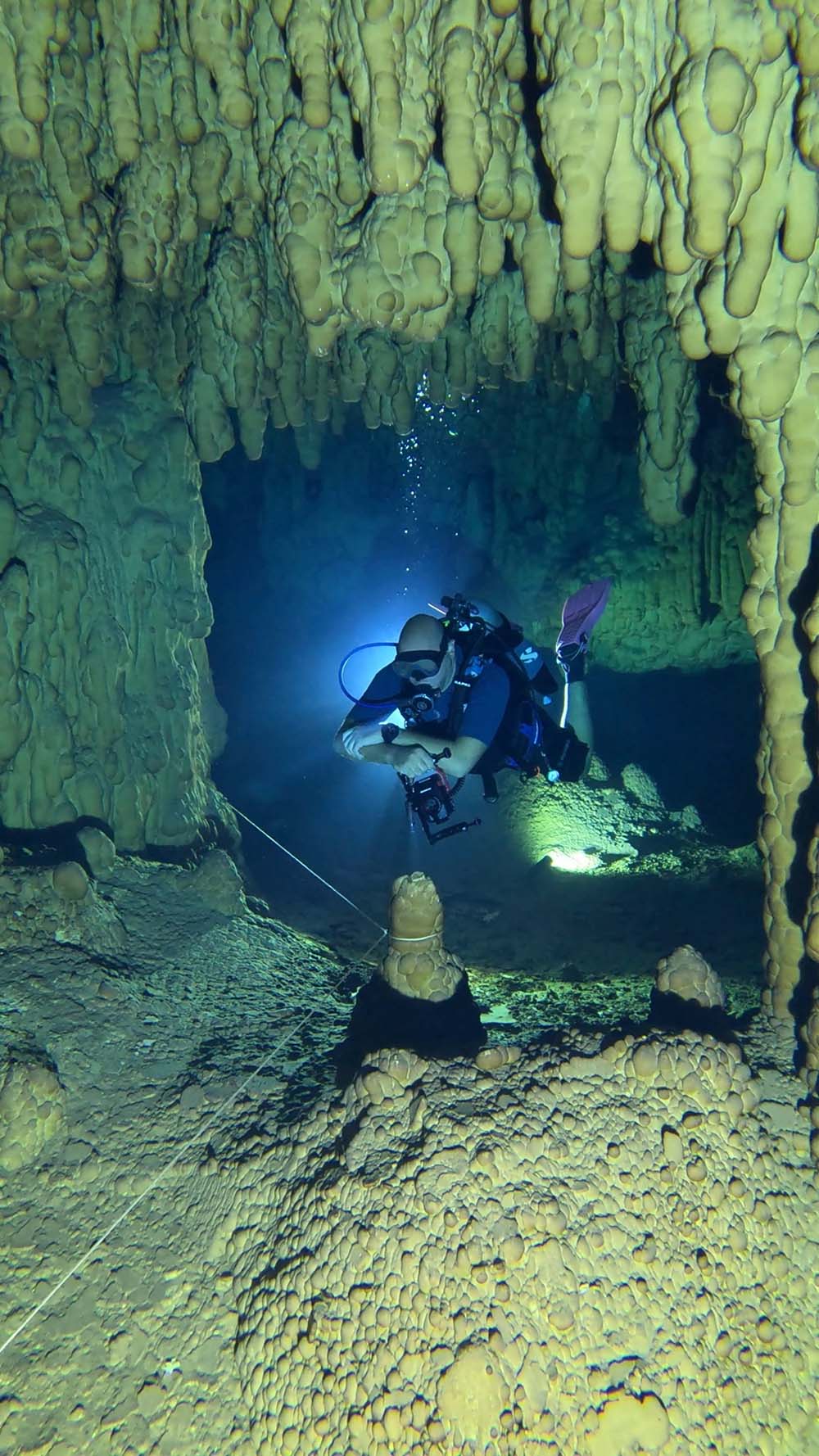
Diving in a cenote means entering fresh water that is still, calm, and extraordinarily clear. Visibility can be stunning; the sun’s rays cut through the water, and the slightest movement transforms that light into glowing curtains. In some places, the halocline appears: a boundary between fresh and salt water that distorts your vision and makes it feel as though you are crossing from one world into another.
The Yucatán Peninsula is home to thousands of cenotes connected to underground systems, and Sac Actun is recognized as the longest underwater cave system in the world. But no two cenotes are alike, and that is why one is never enough. Here, you have thousands of cenotes to explore, and every dive reveals a different face of Mexico underwater.
Cenotes are not just beautiful. They are spaces carved over geological eras in limestone, places that preserve thousands of years of history. Every stalactite and stalagmite you see has formed drop by drop, at an astonishingly slow pace, over hundreds or even thousands of years; many of these formations take millennia to reach their size. For the Maya, cenotes were also sacred places connected to Xibalba, the underworld, and were used for rituals and offerings. But their value goes far beyond cultural memory: within these systems, fossils of prehistoric animals such as mastodons, giant ground sloths, tapirs, peccaries, and saber-toothed cats have been found, as well as pottery and ancient human remains like Naia, discovered in Hoyo Negro, one of the oldest and most complete human skeletons found in the Americas.
The good news is that you do not need to be a cave diver to experience this. If you are already Open Water certified, you can enjoy recreational cavern diving guided by a professional. You do not need different equipment or cave training for a cenote dive, where you always remain within the daylight zone and with a directly visible exit. Cave diving, on the other hand, goes beyond that zone and requires specific training.
There are oceans in many parts of the world. But cenotes, these beautiful and extensive, exist only here.
With Liquid Earth Explorers, you can discover cenotes from the recreational side through guided, safe, and personalized experiences for divers who want to explore this unique environment, always with respect for the natural surroundings that make it so special. And for those who feel this first dive awakens something more, Divers UnderGround offers the opportunity to keep advancing, from sidemount training to cave training and beyond to more technical and specialized levels. And if you want to make this fascinating world your profession, you can also take the next step into professional training and turn your passion into your life’s path.
Liquid Earth Explorers and Divers UnderGround are sister companies, separated by a clear purpose: to specialize in each area of diving to offer a higher-quality experience, greater focus, and higher standards. Behind both is the same team of Instructor Trainers, with more than 19 years of experience guiding, training, and supporting divers in Mexico.